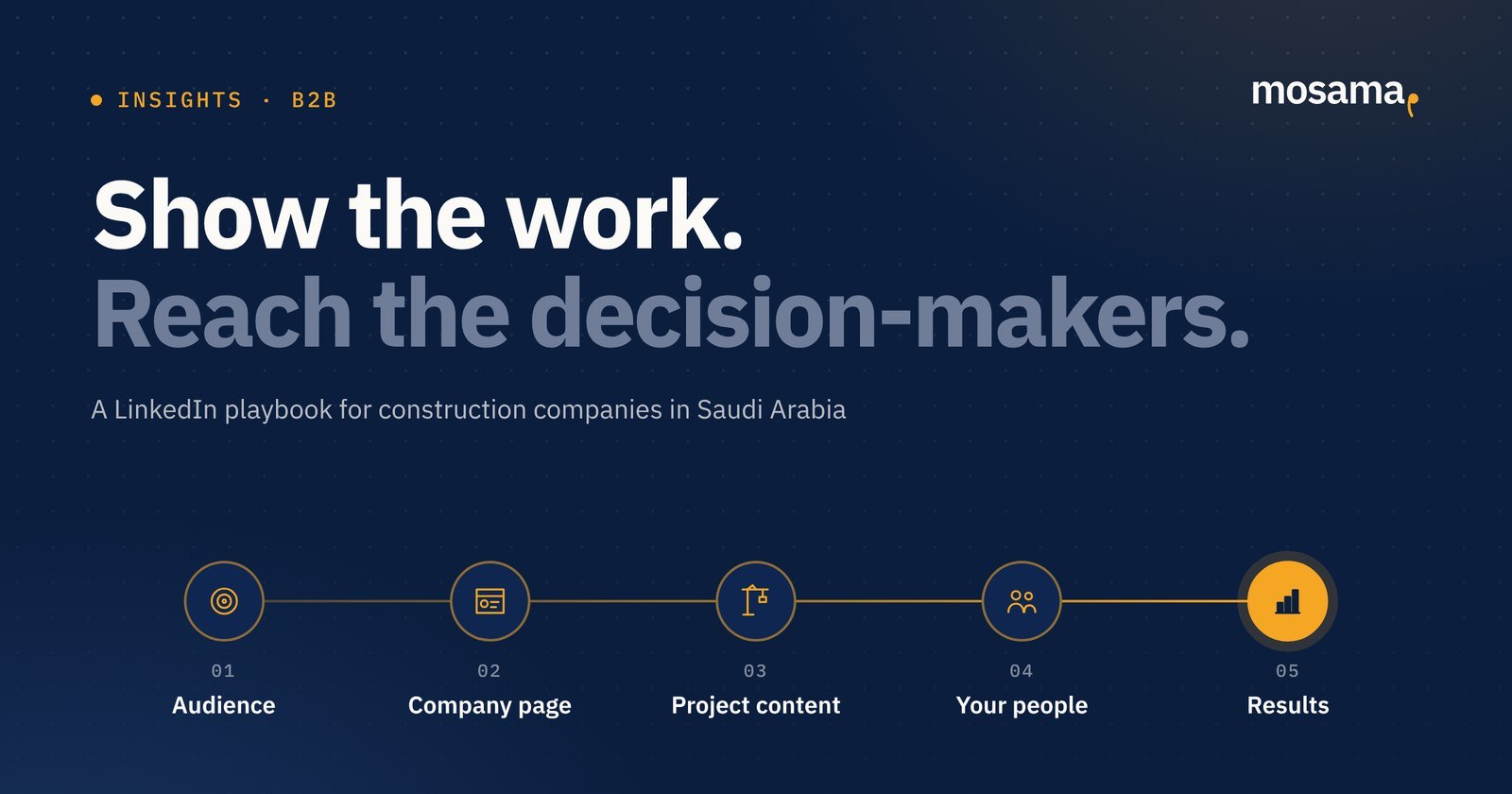
In construction, work is won on reputation. Before a developer invites a contractor to tender, or a consultant adds a company to a pre-qualification list, someone checks that company online. More and more often, that check happens on LinkedIn.
Yet most contractor pages in Saudi Arabia look the same: a logo, a few national-day greetings, and long silences between them. The work itself, often impressive on site, is almost invisible. Here is a practical playbook for construction and contracting companies that want LinkedIn to bring real opportunities, not just likes.
1. Know who you are talking to
A contractor’s audience on LinkedIn is small, specific and senior. Write for these people:
- Developers and project owners, who decide who gets invited to tender.
- Engineering consultants, who review qualifications and recommend contractors.
- Procurement and pre-qualification teams, who need documents, certificates and proof of past work.
- Main contractors, if you work as a specialist or subcontractor.
- Engineers and skilled talent, because a strong page also makes hiring easier.
Every post should be useful to at least one of them. A greeting card rarely is.
2. Fix the page before you post
Your company page is your shop window. Before any campaign, make sure it answers the questions a decision-maker has in the first ten seconds:
- A banner that shows a real project, not a stock image of cranes.
- An About section with facts: the sectors you work in, the regions you cover, your specialties and your years of experience.
- Arabic and English, because both are used by owners, consultants and procurement teams in the Kingdom.
- Your company profile as a PDF in the Featured section, ready to download.
- A working website link and contact details, so interest does not hit a dead end.
3. Post what only a contractor can show
Your biggest advantage is that your work is visual and real. Use it.
- Project progress: drone shots and time-lapse films from site, from groundwork to handover.
- Handovers and milestones: a finished project, a structure topped out, a facility ready to operate.
- Safety: HSE milestones, training days, safe working hours. For owners, safety is a deciding factor.
- Quality and certifications: ISO certificates, inspections passed, materials and methods explained simply.
- People: the engineers and site teams behind the work, introduced by name and role.
- Problem and solution: a tight deadline, a difficult site, and how the team solved it.
Explain the scope in every caption: what was built, where, and what your company delivered. A beautiful drone shot without context is just a nice view.
4. Keep a steady rhythm
Consistency matters more than volume. Two or three good posts a week, every week, build more trust than a burst of ten posts followed by two silent months.
Plan a simple monthly calendar that mixes project updates, safety, people and company news, and leave room for national occasions. Occasion posts are fine; they just should not be the only thing on the page.
5. Turn your people into channels
On LinkedIn, people get more attention than logos. The profiles of your CEO, directors and project managers can reach owners and consultants that the company page never will.
Help them with short, ready-to-share posts about projects they led, and encourage your team to share company updates. A project handover shared by the engineer who delivered it is more convincing than any advertisement.
6. Use paid campaigns with precision
LinkedIn advertising is not cheap, so precision matters. Its strength for contractors is targeting: you can reach people by job title, industry, company size and even a list of specific companies you want to work with.
- Promote your best project films to decision-makers in real estate, engineering and industrial companies.
- Share your company profile as a document ad, so procurement teams can read it inside LinkedIn.
- Use lead forms for requests like a capability statement or a site visit.
- Retarget visitors to your website and page, who already know your name.
Start small, test a few messages and audiences, and keep budget for what brings conversations.
7. Measure what matters
Followers and likes are easy to count, but they do not win projects. Track the signals that lead to work:
- Inquiries and messages from potential clients.
- Invitations to tender and pre-qualification requests.
- Meetings and site visits that started on LinkedIn.
- The quality of your followers: how many work in real estate, engineering and construction, in the regions you serve.
Review these monthly and adjust what you post and who you target.
Common mistakes
- Posting only greetings. Occasion posts show you exist, not what you can build.
- Beautiful visuals, no context. A drone shot needs a caption that explains the scope and your role.
- An incomplete page. A missing About section or company profile loses serious buyers.
- Ignoring your people. Your engineers and leaders are your most credible voices.
- Measuring likes. Count inquiries and invitations to tender instead.
A checklist for your page
- Banner shows a real project.
- About section lists sectors, regions, specialties and experience, in Arabic and English.
- Company profile PDF is in the Featured section.
- A monthly content calendar mixes projects, safety, quality and people.
- Every project post explains the scope and your role.
- Leaders and project managers share at least one post a month.
- Paid campaigns target job titles and companies you want to work with.
- Inquiries and tender invitations are tracked every month.
Want help with your page?
I help construction, industrial and B2B companies in Saudi Arabia turn their work into content that reaches decision-makers. See my case studies, or work with me.