“Should I hire an agency, or a marketing manager?” It is one of the most common questions business owners in Saudi Arabia ask when growth slows down or a launch is coming. Most of the time it is the wrong first question.
An agency, an in-house team and a marketing advisor are not three versions of the same thing. Each solves a different problem. Choosing well starts with knowing which problem you have.
What an agency does best
An agency gives you production power: designers, copywriters, media buyers, video teams and specialists you could never hire full time.
Choose an agency when your strategy is clear and you need execution at volume: campaigns, content, ads and production on a steady schedule.
Watch out for an agency doing exactly what you brief and nothing more. If the brief is weak, the work will be busy but not effective. Agencies also serve many clients, so your account will compete for attention, and the people who pitched you are not always the people who run your account.
What an in-house team does best
An in-house team lives inside your business. It knows your products, your customers and your daily priorities, and it can move fast.
Choose an in-house team when marketing is continuous and the volume justifies salaries: a brand that posts every day, answers customers all day and runs campaigns every month.
Watch out for the “one person does everything” trap. Strategy, design, copywriting, media buying, filming and analytics are different skills. One hire rarely covers them all, and a team without senior leadership tends to stay busy without moving the numbers.
What a marketing advisor does best
A marketing advisor brings senior thinking without a full-time senior salary. The job is direction: where to grow, which audiences and channels to focus on, what to measure, and how to organise the people who execute.
Choose an advisor when:
- You are about to launch, or results have stalled and you don’t know why.
- You have an agency or a small team, but no one setting direction.
- You want to know what team to build before you start hiring.
- You need a plan you can hand to any agency or team and hold them to.
Watch out for advisors who stop at the presentation. A strategy nobody executes is an expensive document. Look for someone who stays close to execution, reviews the work and is accountable for the numbers.
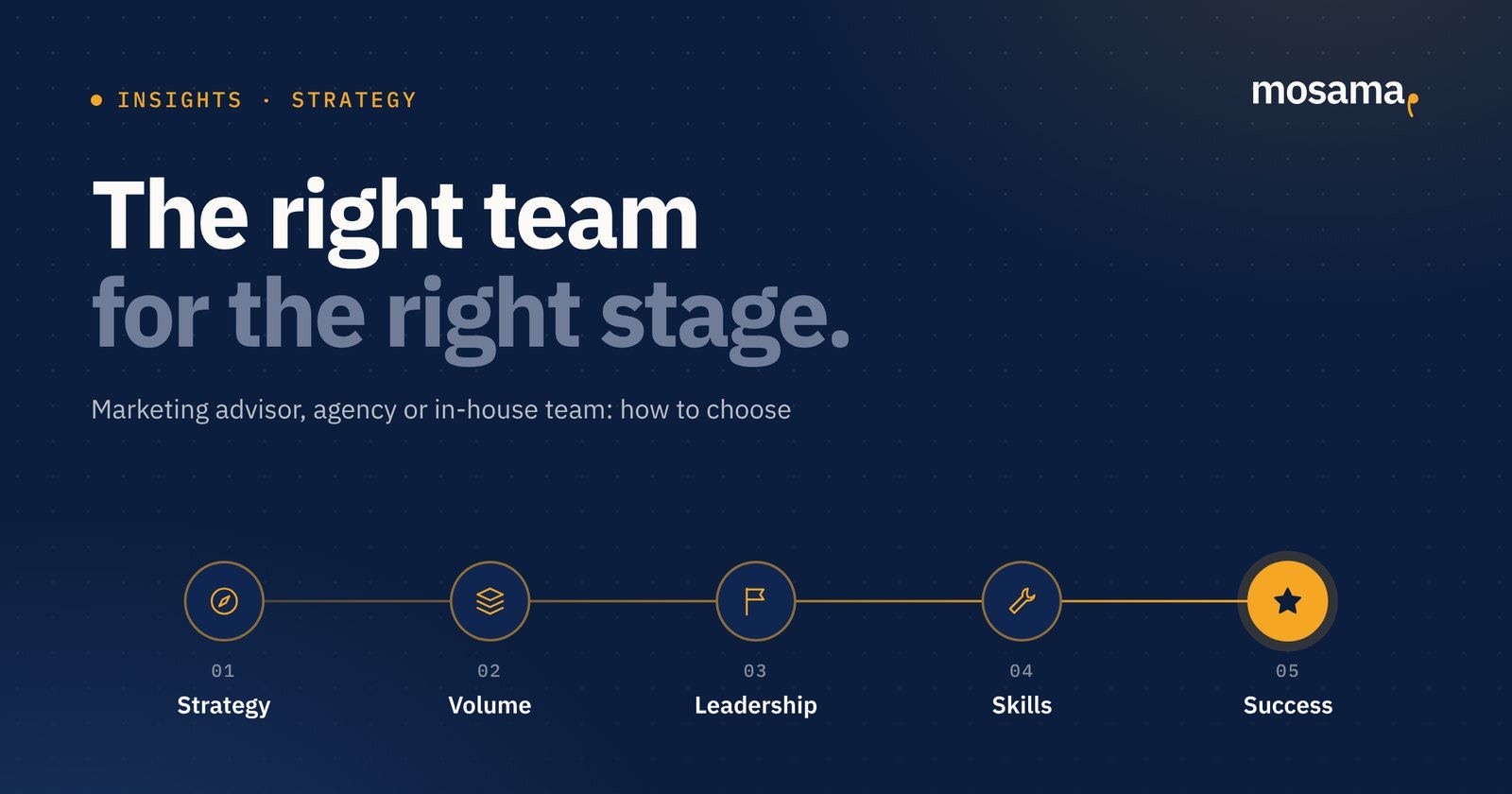
Five questions to choose the right setup
- Do you have a clear strategy? If not, start there. More execution will not fix a missing direction.
- How much marketing do you do every month? High, daily volume favours an in-house team. Campaign peaks favour an agency.
- Who leads marketing today? If the answer is “the owner, in their spare time”, you need senior direction first.
- What skills are missing? List them honestly: strategy, content, design, video, media buying, analytics.
- How will you measure success? Without clear goals, no setup can be judged fairly.
The setup that fits each stage
There is no single right answer, but there are patterns that work:
- Launch or relaunch: an advisor to set the strategy and the plan, with freelance or agency production for the launch content.
- Growth: an advisor plus a small in-house team for daily content and customer replies, with an agency or specialists for ads and production.
- Scale: a full-time marketing director leading an in-house team, with agencies for specialist work.
Many businesses move through all three. The mistake is jumping straight to the most expensive setup, or staying in the cheapest one for too long.
Common mistakes
- Hiring one junior to “do all the marketing”. It sets the person up to fail and the business to wait.
- Changing agencies without changing the brief. If the direction stays the same, the results usually do too.
- Paying for a strategy no one executes. Plan the execution and the owner of each task from day one.
- No agreed goals. Agree on what success looks like before you judge any team.
How I work
I work as a marketing advisor who stays with the work: growth and brand strategy first, then the content, campaigns and production that deliver it, with a trusted network of production partners. I also help business owners decide what marketing team to build, and how to brief and manage the agencies they already have.
If you are deciding how to set up your marketing, see my case studies or work with me.