A year ago, an Arabic video ad meant a crew, a location, actors, a voice studio and a week or more of editing. Today a good part of that can be made with AI: scenes, characters, voice-over, music and variations for testing. The cost of trying an idea has dropped sharply.
What has not changed is what makes an ad work: a clear message, a hook that stops the scroll, and a customer who recognises themselves in it. AI changes how a video is made, not why people watch it. This guide covers the workflow, the tools and what drives the cost.
When AI video makes sense
AI video is a strong choice when:
- Filming is slow or expensive: product scenes in many settings, seasonal versions, or places you cannot easily shoot.
- You need volume: several Reels a month, or many versions of one ad to test.
- You are entering a new market: testing Arabic messages before investing in a full production.
- You want to localise existing ads: rebuilding a campaign for Arabic speakers without reshooting it.
It is a weaker choice when the product must be seen in perfect real detail, such as texture-critical food or fashion close-ups, or when a real person’s testimony is the message. In those cases, mixing AI scenes with real footage often gives the best of both.
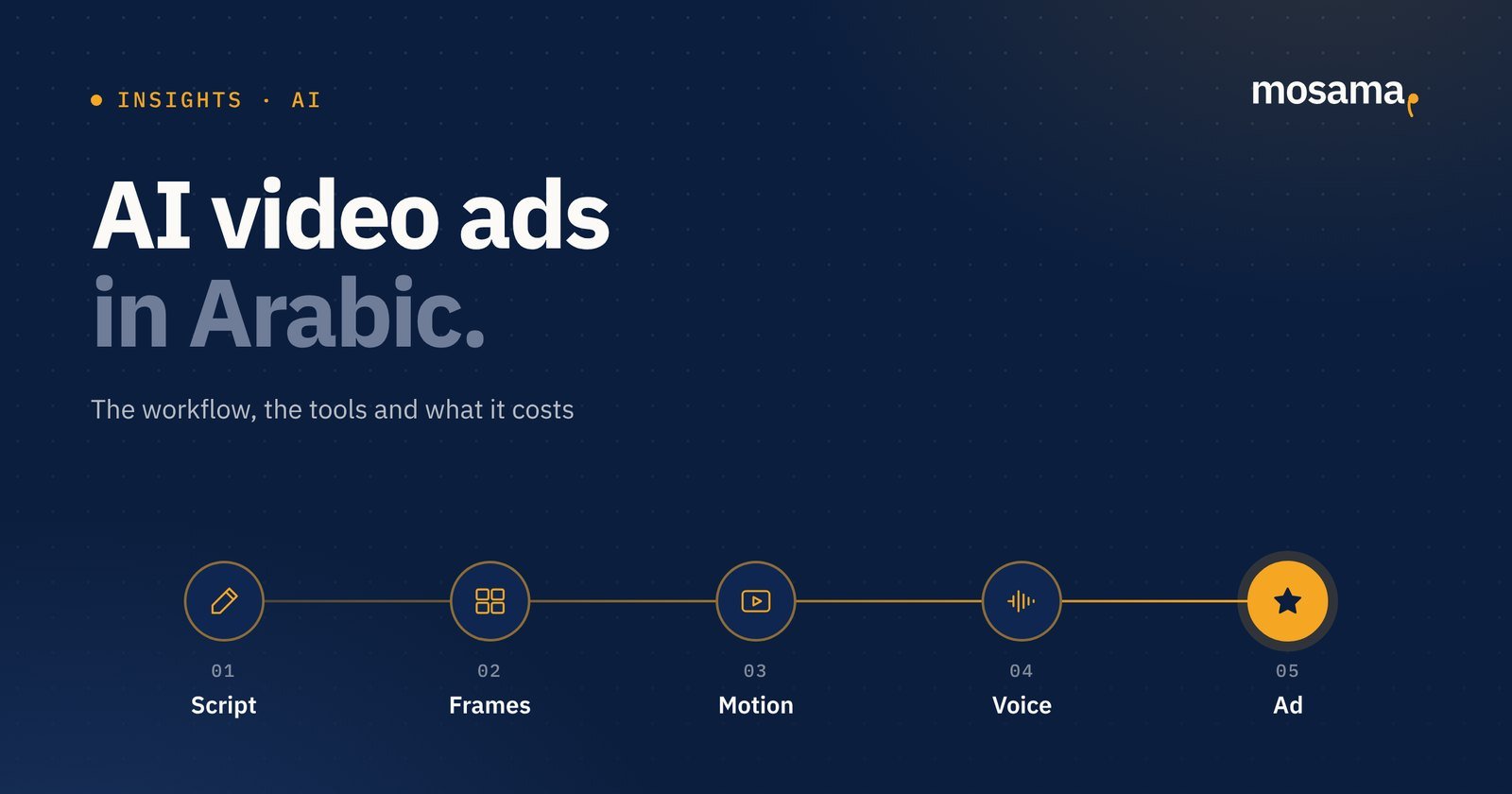
The workflow, step by step
- Brief. The product, the customer, the offer and the one action you want. Without this, AI just produces attractive videos that sell nothing.
- Script. Shot by shot, with the voice-over and on-screen text, written in the dialect of the audience. This is where most of the quality is decided.
- Key frames. Still images that fix the look: characters, setting, colours and the product itself. Approving stills first saves time and money later.
- Animation. Turning the key frames into moving scenes with AI video tools, usually several attempts per shot to get the right one.
- Voice and music. An AI voice or a real voice artist in the right dialect, plus music and sound effects.
- Edit. Assembling the shots, timing, captions, logo and call to action, then exporting in each size you need.
- Revisions and variations. Adjusting the details, then creating versions with different hooks, offers or lengths for testing.
The tools
The tools change every few months, so the skill is choosing the right one for each step, not loyalty to one app. Typical choices today:
- Video generation: Veo, Kling, Seedance and Runway, each with different strengths in realism, motion and consistency.
- Images and key frames: tools such as Nano Banana and Magnific for creating and upscaling frames.
- Voice: ElevenLabs and similar tools for Arabic voice-over, or a human voice artist when warmth matters.
- Music: Suno or licensed music libraries.
- Editing: Premiere Pro, After Effects or CapCut for the final cut.
Check the commercial-use terms of every tool before you publish. Reputable tools allow commercial use on paid plans; free tiers often do not.
Arabic is where most AI ads fail
Most AI tools are trained mainly on English. That shows in Arabic ads:
- Voice-over that sounds foreign. Wrong stress, wrong dialect, or formal Arabic where a casual Saudi or Gulf voice was needed.
- On-screen text with broken letters. Arabic letters must connect and read right to left. Many tools still render Arabic text incorrectly, so text should be added in the edit, not generated in the scene.
- Scenes that do not feel local. Clothing, homes, streets and family moments that look generic or imported.
The fix is a human who knows the audience: someone who writes the script in the right dialect, checks every line of voice-over and directs scenes that feel familiar.
What drives the cost
AI video is cheaper than a full shoot in most cases, but it is not free. The main cost drivers:
- Length and number of scenes. A 15-second Reel with four shots is very different from a 60-second product film.
- Consistency. Keeping the same character or product identical across many shots takes more attempts and more time.
- Realism. Close-ups of real products and people need more work than stylised scenes.
- Voice. A premium human voice artist costs more than an AI voice.
- Volume. Monthly packages lower the cost per video because the brand look, characters and process are already set.
- Revisions. Clear approval at script and key-frame stage keeps revisions small.
The budget mistake is paying for production and skipping the script. A beautiful video with a weak message costs the same as a good one and returns far less.
How to judge an AI ad before you publish
- Does the first second give a reason to keep watching?
- Does the voice sound like your customer, in their dialect?
- Is every word of Arabic text correct and readable?
- Is the product shown clearly and accurately?
- Is there one clear action at the end?
- Would you be comfortable if a customer found out it was made with AI?
The last question matters. AI should present your real product and offer honestly, not invent results or fake testimonials.
How I work
I produce AI video ads and Reels in Arabic and English, scripted by a marketer and built around the real product. See the AI video production service, the monthly AI video packages starting from 1,000 SAR, or samples in the Studio.