Most small businesses in Saudi Arabia do not fail because of the product. They struggle because marketing happens at random: posts with no goal, ads launched only when sales drop, and a budget spent without anyone knowing what worked.
A marketing plan does not need to be a fifty-page document. It needs to answer a few questions clearly, and then be executed consistently. These are practical steps for a small business on a limited budget.
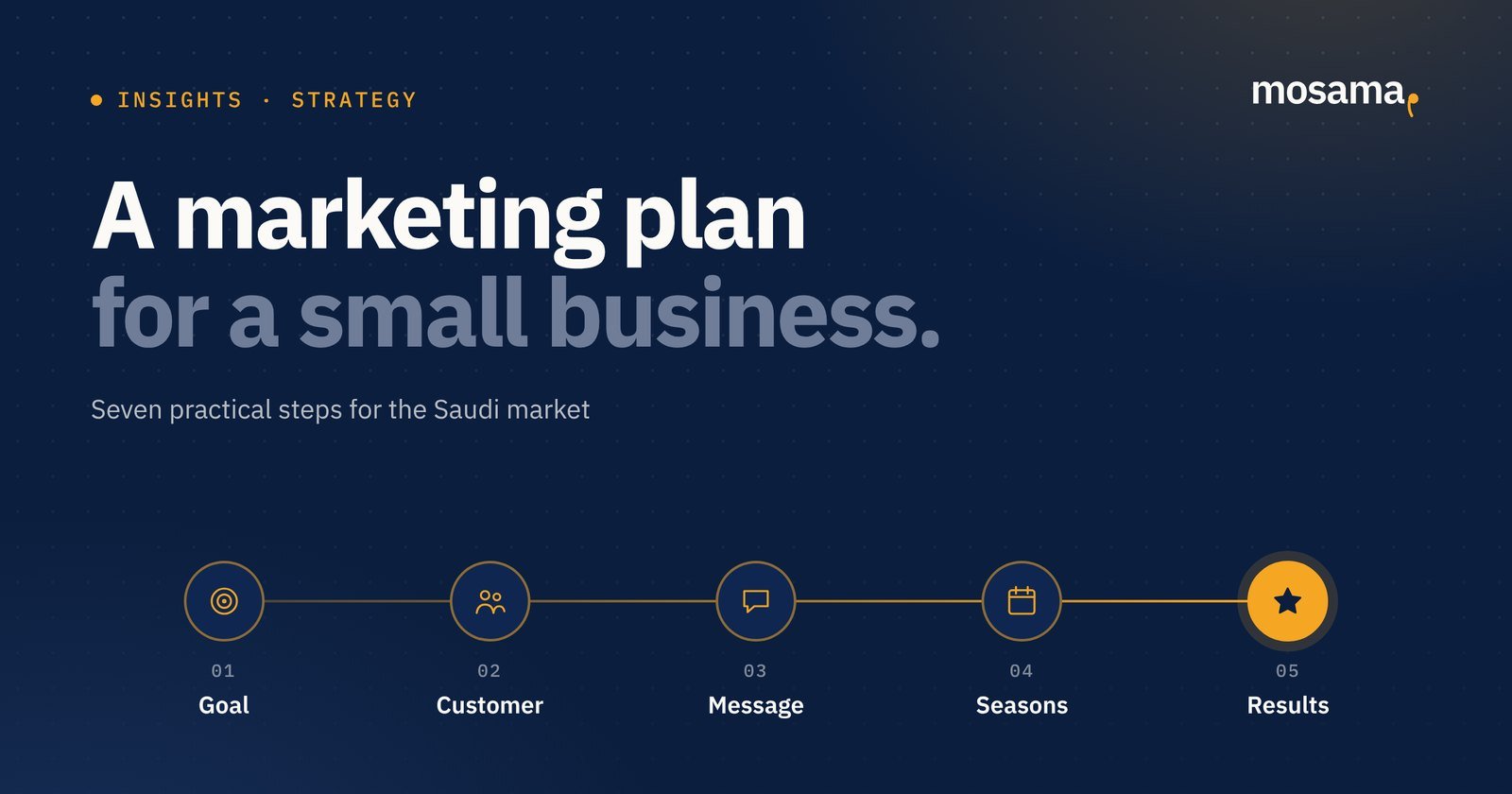
1. Set one 90-day goal
Start with one measurable goal: more orders, more bookings, or new customers in a specific district or city. Several goals at once spread the budget and the effort too thin.
2. Know your customer precisely
“Everyone” is not a customer. Write a short description of yours:
- Who are they, where do they live, roughly how old are they?
- What problem does your product solve for them?
- Where do they spend their time online?
- What makes them trust you and buy?
Talk to ten current customers. You will learn more from them than from any report.
3. Write a clear message
One sentence that explains why a customer should choose you over a competitor. Not “high quality and fair prices”, which everyone says. Find a real, specific advantage and write it in your customer’s language and dialect.
4. Choose two channels only
A small business does not need to be everywhere. Pick the two channels closest to your customer:
- Snapchat and TikTok: strong reach among young people and families in Saudi Arabia.
- Instagram: important for restaurants, cafés, beauty and fashion.
- Google Maps and a Business Profile: essential for any business customers visit in person, if you have an address that can be verified.
- LinkedIn: for companies that sell to other companies.
- WhatsApp: for answering customers and repeat orders.
Master two channels, then add a third once the first ones prove themselves.
5. Plan content around the seasons
The Saudi market moves with the seasons: Ramadan, the two Eids, Founding Day, National Day, back to school and White Friday. Put them in a calendar from the start and prepare for each one weeks ahead. The Saudi marketing calendar is a good starting point.
6. Set a budget and split it
There is no right number for everyone, but there is a rule: a steady monthly budget beats one large burst. Split it roughly into:
- Paid ads: to reach new customers quickly.
- Content: photos, design and video. AI video can cut this cost a lot.
- A testing reserve: to try new ideas without touching what works.
7. Measure every month
Pick three numbers and track them monthly: new customers, the cost to win a customer, and the share of customers who come back. And ask every new customer how they heard about you. A simple answer saves a lot of guessing.
Plan checklist
- One measurable 90-day goal.
- A clear description of the target customer.
- One message that sets you apart from competitors.
- Only two main channels to start.
- A content calendar that includes Saudi seasons.
- A steady, split monthly budget.
- Three numbers you track every month.
Common mistakes
- Copying what the big competitor does. Their budget and goals are different from yours.
- Stopping marketing when sales improve. Then starting from zero when they drop.
- Judging ads by likes. The real measure is sales and customers.
- Ignoring existing customers. Bringing them back costs far less than finding new ones.
Need help with your plan?
I help small and mid-sized businesses in Saudi Arabia build a clear marketing plan and execute it, from strategy to content and campaigns. See the marketing consultant in Saudi Arabia page, or book an intro call.