Saudi Arabia and the UAE are among the most attractive markets in the world for consumer brands: young populations, high smartphone use, strong spending power and a real appetite for new products. For Malaysian and Asian brands there is an extra advantage. Halal is the default, not a niche, and many products that succeed at home already fit the region’s values.
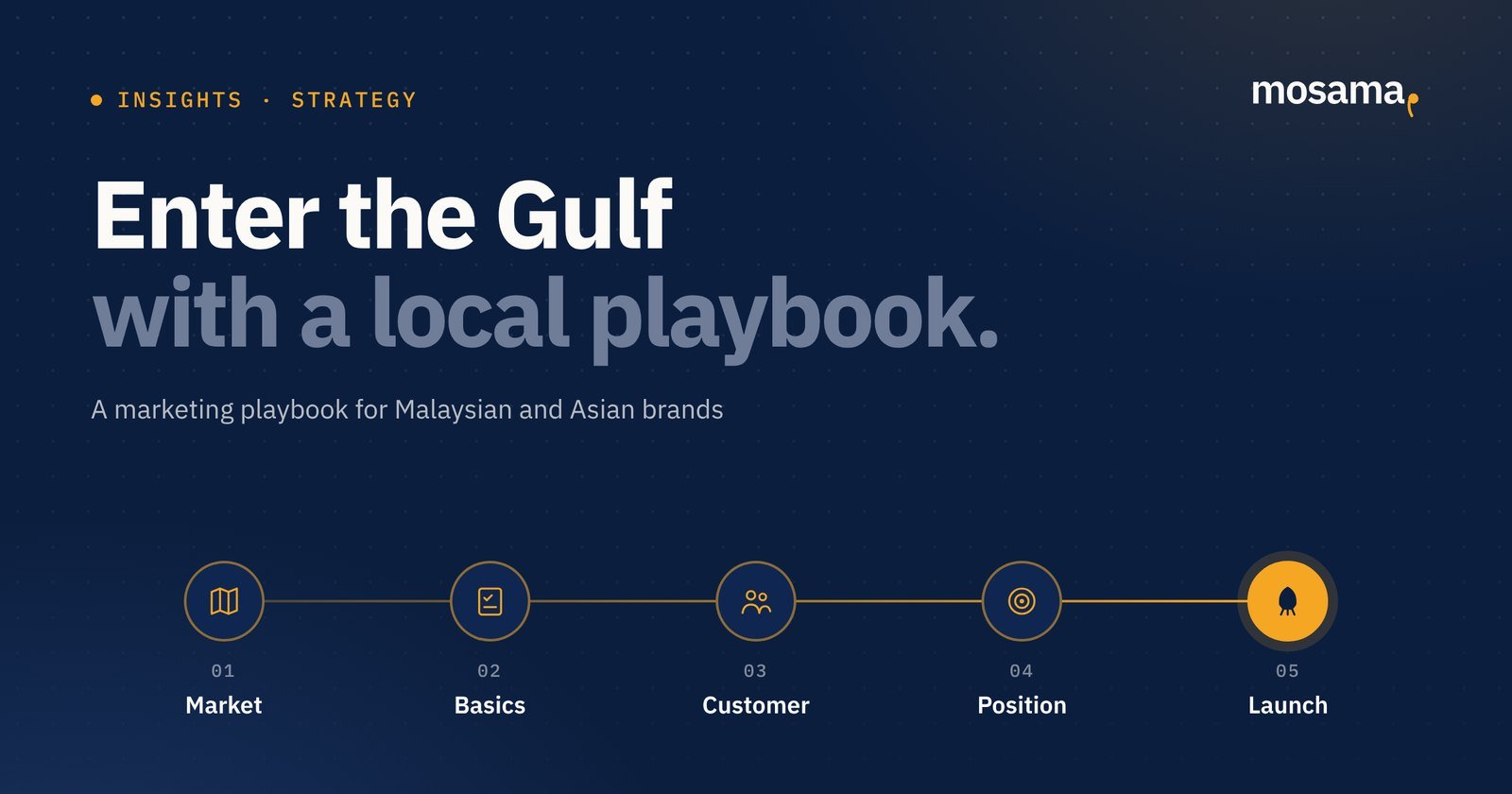
But a good product that sells in Kuala Lumpur or Jakarta does not sell itself in Riyadh or Dubai. The brands that win treat the Gulf as a new market to learn, not an export destination to ship to. This playbook covers what to get right, in the order it matters.
1. Choose where to start
“The Gulf” is six countries with different sizes, rules and buying habits.
- Saudi Arabia is the largest market, with the biggest population and a fast-growing retail and e-commerce scene. It rewards brands that commit for the long term.
- The UAE is smaller but international and easy to test in. Many brands launch in Dubai first, learn, then expand.
- Qatar, Kuwait, Bahrain and Oman are smaller markets that often follow once a brand has proof in one of the two above.
Pick one starting market, learn there, and expand with evidence instead of spreading a small budget across six countries.
2. Check what you need before you market
Marketing comes after the basics, not instead of them. Before you spend on ads:
- Confirm product registration and labelling rules for your category (food and cosmetics in Saudi Arabia go through the Saudi Food and Drug Authority).
- Check that your halal certification is accepted for the market you chose.
- Decide your route to the customer: a distributor, a marketplace, your own online store, or retail partners.
- Prepare Arabic labels, product pages and customer service.
- Plan delivery times, returns and local payment methods.
Legal and trade requirements change, so confirm them with specialists. The marketing point is simple: a campaign that sends customers to a product they cannot buy, or a page they cannot read, wastes the budget.
3. Understand the Gulf customer
Gulf customers are online, informed and quick to compare. A few patterns hold across most categories:
- Trust comes before price. Reviews, recognisable faces and a professional Arabic presence matter more than a discount from an unknown brand.
- Social platforms work differently. Snapchat and TikTok are central in Saudi Arabia, Instagram remains strong across the region, and X still shapes conversation. Plan for the platforms your customers actually use.
- Seasons drive spending. Ramadan, the two Eids, national days and White Friday change what people buy and when. A launch that ignores the calendar competes at the wrong moment.
- Local payment and delivery expectations are high. Mada cards, Apple Pay and buy-now-pay-later services are part of the checkout customers expect.
4. Position the brand for the region
Your home positioning may not travel. “Made in Malaysia” can be a strength when it signals quality and halal assurance, but customers still need a reason to choose you over local and global brands already on the shelf.
Answer three questions in one sentence each:
- Who is the customer in this market? Not “everyone in Saudi Arabia”. A specific group with a specific need.
- Why should they choose you? One clear advantage they care about.
- Why should they believe you? Certification, reviews, results, a trusted partner or a known face.
5. Localise the message, don’t translate it
Translated copy is easy to spot and quick to ignore. Gulf customers expect Arabic that sounds like them: the right dialect for social content, clear Modern Standard Arabic for product information, and references that fit local life.
Localisation also covers visuals. Casting, dress, settings and family scenes should feel familiar. This is where AI video production helps new brands: you can create Arabic ads in local dialects and settings without flying a crew in for every test. See how it works in AI video production.
6. Launch in phases
A launch is a series of tests, not one big moment.
- Phase 1: Prove. One market, one or two hero products, a small set of channels. Measure the cost to win a customer and how many come back.
- Phase 2: Build. Add creators and partners who match the brand, grow the content, and widen distribution where the numbers support it.
- Phase 3: Expand. Move to the next market with a playbook that already works.
Agree on the numbers that decide each move before you start: cost per customer, repeat purchase rate and return on ad spend.
7. Work remotely without losing the local view
You do not need a large team on the ground to start, but you do need local judgement. Saudi Arabia is on GMT+3 and Malaysia on GMT+8, so the Gulf morning is the Kuala Lumpur afternoon. A weekly video call, shared documents and a clear owner for each task keep a remote setup moving.
What remote work cannot replace is someone who sees the market every day: the ads customers respond to, the competitors who just launched, the season about to start.
Common mistakes
- Launching in all six countries at once. The budget spreads thin and nothing gets proven.
- Translating the home campaign. Same visuals, same jokes, Arabic subtitles. It rarely lands.
- Ignoring the calendar. Launching into Ramadan without a Ramadan plan, or going quiet during the busiest weeks.
- Judging too early. New markets need time to build trust. Decide on agreed numbers, not on the first two weeks.
How I can help
I work with brands entering Saudi Arabia and the Gulf, remote or on site: market research, positioning, Arabic messaging, launch plans, and the content and AI video that bring them to life. See the Gulf market entry service, the Saudi marketing calendar, or get in touch.